Conference stage design is one of the highest-leverage investments in corporate event production. The stage is where your speakers stand, your content displays, and your audience focuses for hours at a time. A well-designed stage communicates organizational credibility, reinforces brand identity, and creates the visual environment that shows up in every photo and recording taken at the event. A poorly designed stage undermines all of that — no matter how compelling the content is.
This guide covers the full spectrum of conference stage design — from minimalist executive formats to full theatrical productions — with practical recommendations on lighting, display technology, set design, and budget allocation for each event tier.
Conference Stage Design Tiers and Investment Levels
| Design Tier | Key Elements | Best For | Budget Range |
|---|---|---|---|
| Essential | Single screen, podium, basic front wash | Internal meetings, small conferences | $5,000–$15,000 |
| Professional | Dual screens or LED wall, stage lighting, branded backdrop or logo | Annual meetings, leadership conferences | $20,000–$60,000 |
| Premium | LED video wall, intelligent moving lights, custom set pieces, confidence monitors | Sales conferences, product launches | $60,000–$150,000 |
| Broadcast | Full LED backdrop, IMAG cameras, theatrical lighting grid, live graphics | National conferences, award shows, brand launches | $150,000–$500,000+ |
Key Elements That Define Conference Stage Design
A conference stage is the sum of several distinct design layers working together. Understanding each layer helps you prioritize investment and make trade-offs that are visible to your audience versus those that aren’t.
Display Technology: LED Wall vs Projection
Your main display is the centerpiece of the stage. LED video walls deliver higher brightness, better color, and a seamless surface that photographs beautifully. Projection screens are more budget-friendly and sufficient for controlled lighting environments. For any event where the stage will be photographed extensively or livestreamed, LED is the professional standard. See our full comparison in the LED vs projection guide.
Stage Lighting: The Single Highest-Impact Element
Nothing transforms a stage more dramatically than well-designed lighting. A basic stage wash with front fill and uplighting in brand colors can make a modest set look polished and intentional. Moving heads add dynamic capability for transitional moments between speakers or sessions. A skilled lighting designer working with your brand palette is often the best ROI investment in stage production.
Stage Structure and Risers
Stage height matters enormously for sightlines. Audiences should be able to see the presenter’s full body from any seat in the room. For rooms over 200 people, a minimum 18–24 inch stage height is standard. Wider rooms may benefit from a thrust stage configuration that extends the presenter area into the audience.
Backdrop and Set Design
The area behind the presenter tells a visual story about the organization. Options range from simple branded fabric backdrops printed with a logo and tagline to custom-built scenic elements with dimensional props, architectural features, and integrated lighting. The backdrop is also the most photographed element — it frames every speaker photo from the event.
Confidence Monitors
Often overlooked until a speaker turns their back to the audience to read a screen — confidence monitors facing the presenter show current slides and speaker notes without requiring them to look away from the audience. Floor monitors, small screens at the downstage edge, or in-ear teleprompters are all options. Essential for polished presentations with complex content.
Furniture and Stage Furnishings
Panel discussions, fireside chats, and awards segments require appropriate stage furniture. Modern event design favors sleek, height-adjustable stools and low tables over traditional hotel chairs and podiums. Furniture should be selected to align with brand identity — startups and tech companies often use different aesthetics than financial services or pharmaceutical organizations.
Stage Design Budget Breakdown by Element
| Stage Element | Budget Range | Notes |
|---|---|---|
| Main Display (LED Wall) | $8,000–$40,000+ | Scales with wall size; includes hardware, setup, and LED tech |
| Lighting Design + Equipment | $5,000–$30,000 | Includes LD design fee, fixtures, console, crew |
| Stage Risers/Platform | $1,500–$8,000 | Rental; size-dependent |
| Backdrop or Scenic Set | $2,000–$25,000+ | Printed fabric is cheapest; custom scenic builds range widely |
| Confidence Monitors | $800–$3,000 | 2–4 monitors + display hardware + cabling |
| Stage Furniture | $500–$5,000 | Rental; style and quantity dependent |
Stage Design Ideas by Event Format
Keynote Conference (Single Presenter Format)
Centered LED wall or projection screen, single podium or roaming presenter area, strong front wash with no harsh shadows on the presenter’s face, and a minimal branded backdrop. The visual hierarchy puts the screen content first, the presenter second, and the organization’s brand as ambient context. Add gobo lighting with company logo or pattern projected onto the stage floor for a premium touch at relatively low cost.
Panel Discussion Format
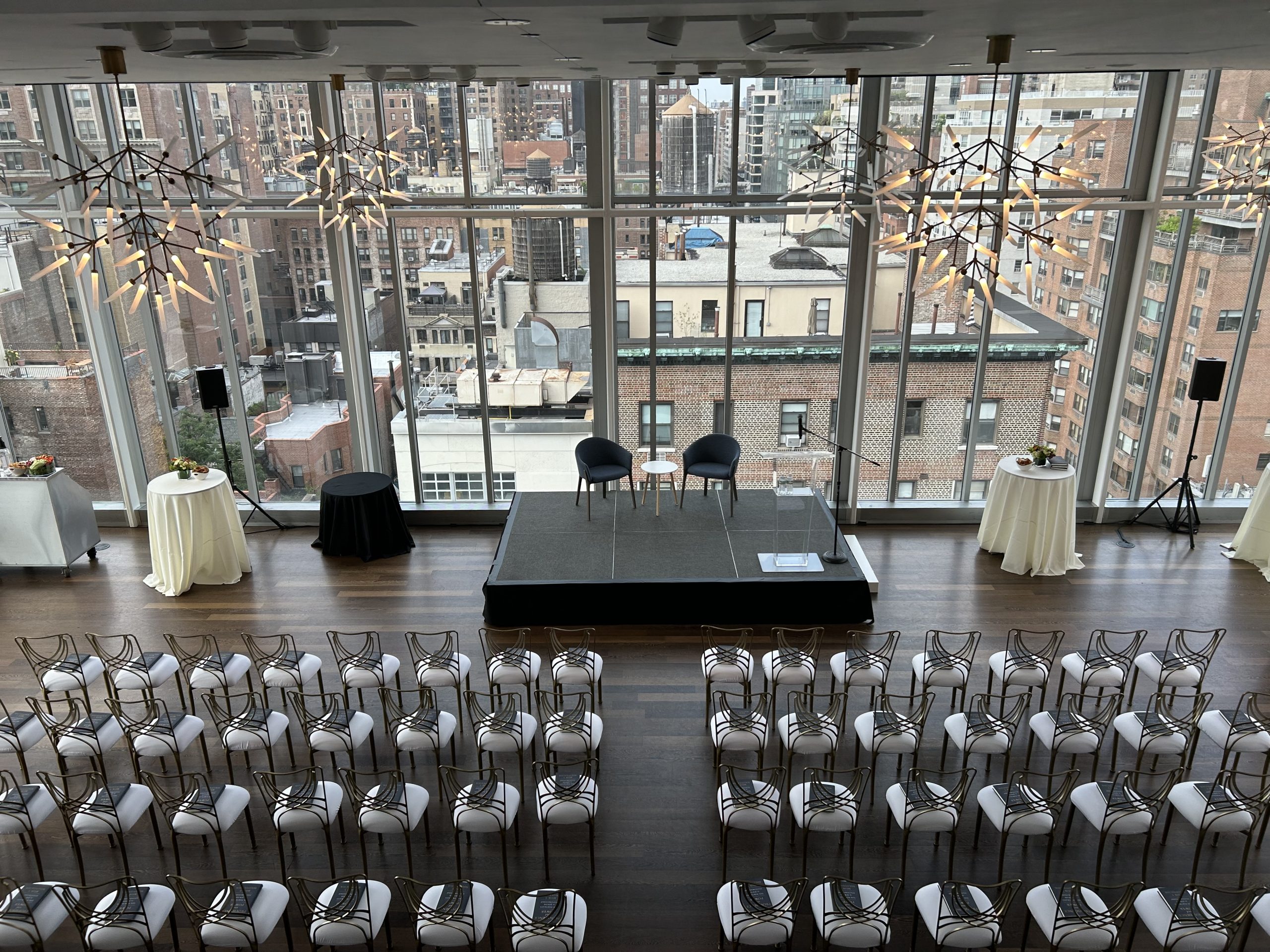
A curved or angled panel table allows moderator and panelists to see each other without turning away from the audience. Side screens (or a wide LED wall) show content alongside the panel. Individual wireless mics for each seat. Consider a lower-profile stage configuration (12 inches rather than 24) so panel participants appear more approachable and conversational rather than elevated above the audience.
Awards Gala Stage
Maximum visual impact: full LED wall as both backdrop and dynamic content surface, intelligent lighting with color-changing capability for each award category, a center staircase from stage level to floor level for award recipients, and IMAG cameras to show recipients’ faces on the main wall as they approach. The stage design for an awards show serves double duty as a photographic backdrop for every winner.
Product Launch Event
Product launch stages benefit from asymmetric design — the presenter doesn’t need to compete visually with the product reveal. Consider an LED wall that can go dark for a dramatic product reveal moment, flanked by practical elements like pedestals, minimal furniture, and spotlighting that can focus precisely on the product. This format is where a skilled lighting designer pays for themselves most obviously.
How to Approach Stage Design Planning
Start with your room’s physical constraints. What’s the ceiling height? Where are the rigging points? How far is the back row from the stage? Can the room be fully darkened? These answers determine what’s physically possible before creative ideation begins. A site survey with your production team is the prerequisite for any serious stage design discussion.
Define your brand parameters before engaging a stage designer. What are your primary and secondary brand colors? Is the visual language of your organization formal and traditional or modern and minimal? Do you have a brand style guide that specifies typefaces, motion graphics guidelines, and color usage? Share this with your production team — everything that appears on stage should feel like a seamless extension of your brand identity.
Build your content around your stage, not the other way around. Too many events have speakers deliver presentations designed for a laptop screen that then get projected on a 14-foot wall where they look inadequate. Brief presenters on the stage dimensions and the content aspect ratio well in advance so their visuals are designed for the environment they’ll be shown in.
Ways to Maximize Stage Design Impact on a Budget
- Invest in lighting first: A well-lit stage with a basic backdrop looks significantly better than an elaborately designed set with flat lighting. Lighting is the highest ROI element in stage design.
- Use brand color uplighting: Uplighting the perimeter of the room in brand colors costs a fraction of full lighting design but transforms the entire visual environment.
- Invest in a printed fabric backdrop: A high-quality printed backdrop with your brand mark, event name, and logo creates a professional photographic environment for under $2,000.
- Rent rather than build: Custom scenic builds are expensive and one-use. Rented stage elements — risers, furniture, truss, drape — can be combined creatively without custom fabrication costs.
- Design for photography: Before finalizing stage design, ask: what will this look like in a photo? The moments that live on from your event are the photographs — design the stage to be photogenic.
- Simplify backdrop complexity: A clean, single-color or gradient fabric backdrop with strong branding often outperforms a busy, multi-element backdrop that distracts from the presenter and content.
Frequently Asked Questions
How early should I start stage design planning?
For events with custom scenic elements or LED walls, begin stage design discussions 8–12 weeks before the event. Printed backdrops require 2–3 weeks for design and production. Lighting design should be finalized at least 4 weeks out so the LD has time to program cues before arriving on-site.
Do I need a lighting designer or can the AV crew handle it?
For events where lighting is a significant part of the experience — awards shows, product launches, galas — a dedicated lighting designer (LD) is worth the investment. For standard corporate conferences, an experienced AV technician who also operates lighting can handle a basic design. The distinction matters most for programming complexity, not fixture count.
What’s the best backdrop option for a speaker photography backdrop?
A fabric backdrop printed with your event name, company logo, and brand colors at high resolution creates a clean, professional background for speaker photos. Glossy materials create unwanted reflections under stage lighting — matte fabric finishes photograph best.
How high should a conference stage be?
18–24 inches is standard for most ballroom and conference center stages. Higher stages (30–36 inches) improve sightlines in rooms over 500 people but require steps and may feel imposing for conversational formats like panels. Always include accessible ramp access in addition to stairs.
Can I reuse stage design elements across multiple events?
Yes — branded backdrops, custom furniture, and scenic elements can all be reused. Fabric backdrops store easily and can be refreshed with event-specific details at low cost. This is one of the best ways to amortize stage design investment across an annual event calendar.
What’s a gobo and when should I use one?
A gobo is a metal or glass stencil placed inside a stage lighting fixture that projects a pattern or logo onto a surface. Logo gobos project your company mark onto the stage floor or backdrop at low cost. Pattern gobos (stars, foliage, geometric shapes) add visual texture. They’re inexpensive and high-impact — worth adding to virtually any corporate stage.
How do I avoid glare on the presenter from stage lighting?
Front fill lights positioned below the sightline of the audience provide even facial illumination without harsh shadows or glare. Backlights create depth and separation from the backdrop but need to be aimed precisely. A skilled lighting technician can adjust angles on-site during rehearsal — allow time for this in your production schedule.
Related AV Services
- LED Video Walls vs Projection for Conferences
- The Complete Corporate Event AV Planning Guide
- Corporate Event Production Cost Guide
- Corporate Event Production Timeline
- How to Choose the Right AV Production Company
Ready to Design a Stage That Makes an Impact?
CitiView AV designs and produces conference stages for corporate events across the Northeast. From keynote conferences to awards galas, our production team handles every element — display, lighting, set, and content — so your stage looks and performs exactly as intended.